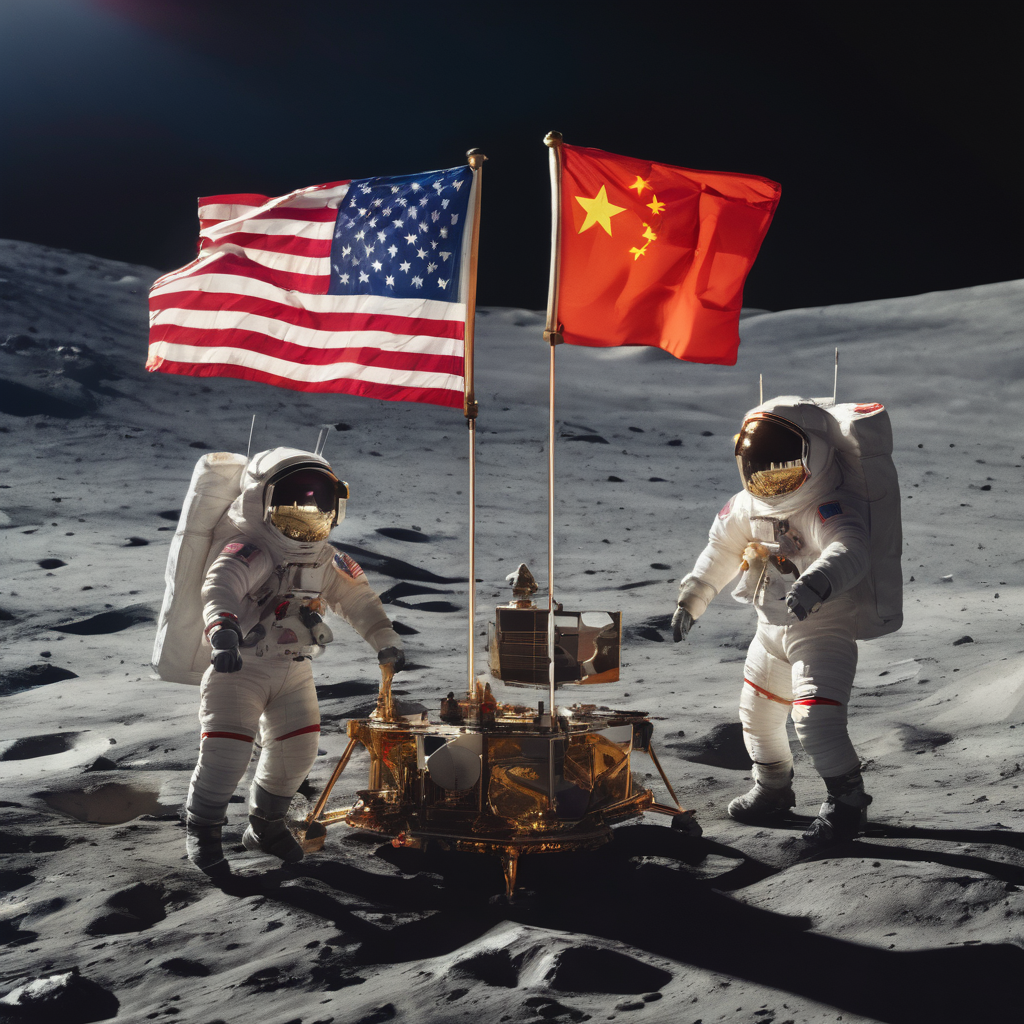
3…2…1.. Blast off! Or should we say, “ready, set, go!”? The mission to the Moon has kicked off in its training, but the US is not the only contender in this race. Its opponent, China, hopes to get to the Moon by 2030, while the US aims to land again by early 2028. You may be wondering, what is this race about? Well, landing on the moon isn’t merely the goal. The end point is creating human life on the Moon and setting space rules, boundaries, and rights.
Often, this race is called a “marathon” due to its long-term goals to reach the South Pole of the Moon. The geography of this area has deep craters that may contain water ice that can be used for drinking, breathable oxygen, and rocket fuel. Some argue that this race isn’t a big milestone, as the US has already landed on the Moon in 1969. However, the winner of this Space Race doesn’t hope to just set foot on the Moon. The winner hopes to achieve future life on the Moon and establish superiority.
A surprising number of students in RIS don’t know about the U.S. vs. China Space Race. We interviewed one class from each grade level, and only 4 out of 63 students polled in RIS knew about this topic. To our shock, in a 6th-grade science class, 0 out of 22 people knew about this. 17% of 7th graders knew about this topic, and 4% of 8th graders knew as well! The lack of knowledge about this topic suggests that learning about it in school might be a beneficial idea, considering that space may play a big role in the future. When asked about learning about this Space Race in our science classes, our principal, Mr. Getchman, mentioned that there is a standard curriculum that we have to follow in school. However, students should be able to learn about current events around the world. He suggests that students ask their teachers at the beginning/end of the period. Mr. Getchman thinks that space is very important for our future and promotes learning about it. However, are a few questions from a student at the end of class enough for students to be fully educated on space exploration?
Not only is there competition between the U.S. and China in this race, but there is also another fight between the average U.S. citizens. From funding questions to winner predictions, this race doesn’t end at blastoff. But are we really “trained” for these long miles? One interesting controversy topic revolves around funding. To put the funding in perspective in today’s time, during the height of the Apollo mission, NASA was funded about $43 billion a year. In contrast, NASA’s entire budget in 2025 was $25 billion. Some people question that we are putting too much focus – financially – on space exploration, and some question that we put too little. Mrs. Kroeger, a mathematics interventionist at RIS, describes space as a hobby of hers. When asked about the focus level we put on space, she stated, “I think it’s important to fund space exploration, because it’s a positive thing that can make us happy. Let’s look for the good in our country”. Like others, Mrs. Kroeger believes that while serious topics such as war require attention, it is equally as important to focus on positive news as well. Another controversial topic revolves around winner predictions. When asked about who he thought would win, Mr. Gechtman, the principal of RIS, confidently stated, “I will never doubt the U.S.”.
Space exploration is an important topic that will forever carry weight for our world. With possible living opportunities and the continuous fight for superiority, this “marathon” might not end at the last mile. The winner of this race will determine the future of space exploration for the world. Are you with or against Mr. Gechtman, who states he will “never doubt the US”? So, who are YOU placing your bets on?